

AI now plays a major role in what, where, when, why, and how content gets seen online.
It has become a core part of how people discover and engage with information—changing how users search, take in information, evaluate credibility, and decide what to trust.
This means that we (content creators, marketers, writers, business owners…everyone, really) must adjust our approach to content in order to stay visible and relevant—both literally (in the SERPS) and figuratively (with the times).
So, whether it’s voice assistants, chatbots, or generative search tools, your content must be ready to serve answers quickly and accurately.
That’s where AI-friendly content comes in.
What Is AI-Friendly Content?
AI-friendly content is content that can be easily understood, categorized, and surfaced by AI-powered engines and tools.
So, that can include:
- Platforms or generative engines such as ChatGPT, Google Gemini, Microsoft Copilot, etc.
- AI-powered results such as AI Overviews within Google.
- AI-powered voice assistants such as Siri and Alexa.
So, if you’re thinking “My audience doesn’t use AI to search,” I can confidently say that yes, they do.
It may not be direct, but if your audience is Googling something, or asking Siri a question, they’re utilizing AI in one way or another.
All of these AI search tools not only offer a different approach to people finding and consuming information, but they have introduced a new way for businesses to be found online.
A New Way to Search
AI search results (in any form) are largely based on intent and context.
As such, many users turn to AI search for its ability to navigate complex, conversational queries. This could include:
- Personalized planning: “Make me a 2-day itinerary for Boston in April, with vegetarian food options in close proximity.”
- Context-based recommendation: “What are good rainy-day activities in Seattle for a couple with a toddler who naps mid-afternoon? We’re arriving at 10 AM, and can’t check into our hotel until 3 PM.”
- Identification: “What classical song is used in commercials and has high-ish operatic singing? It’s not Lacrimosa by Mozart.”
- Comparisons: “I have sensitive, combination skin. Based on online reviews and discussions, which of these moisturizers is best for me?”
- Step-by-step troubleshooting: “My cake fell flat. I followed the recipe linked, didn’t overmix, didn’t substitute, and my baking powder is new. What could’ve caused this?”
Queries like these tend to be more tedious in traditional search, making AI a more succinct way to fulfill a very specific request.
However, AI is also used—and can be beneficial—for more straightforward searches.
For example, imagine you have a scratchy throat.
If you’re talking with a friend and mention that you need a cough drop, they’ll make the logical connection that your throat hurts.
If you search “I need a cough drop” on Google, the AI Overview appears above the traditional search results, providing information on which cough drops to buy and where to buy them.
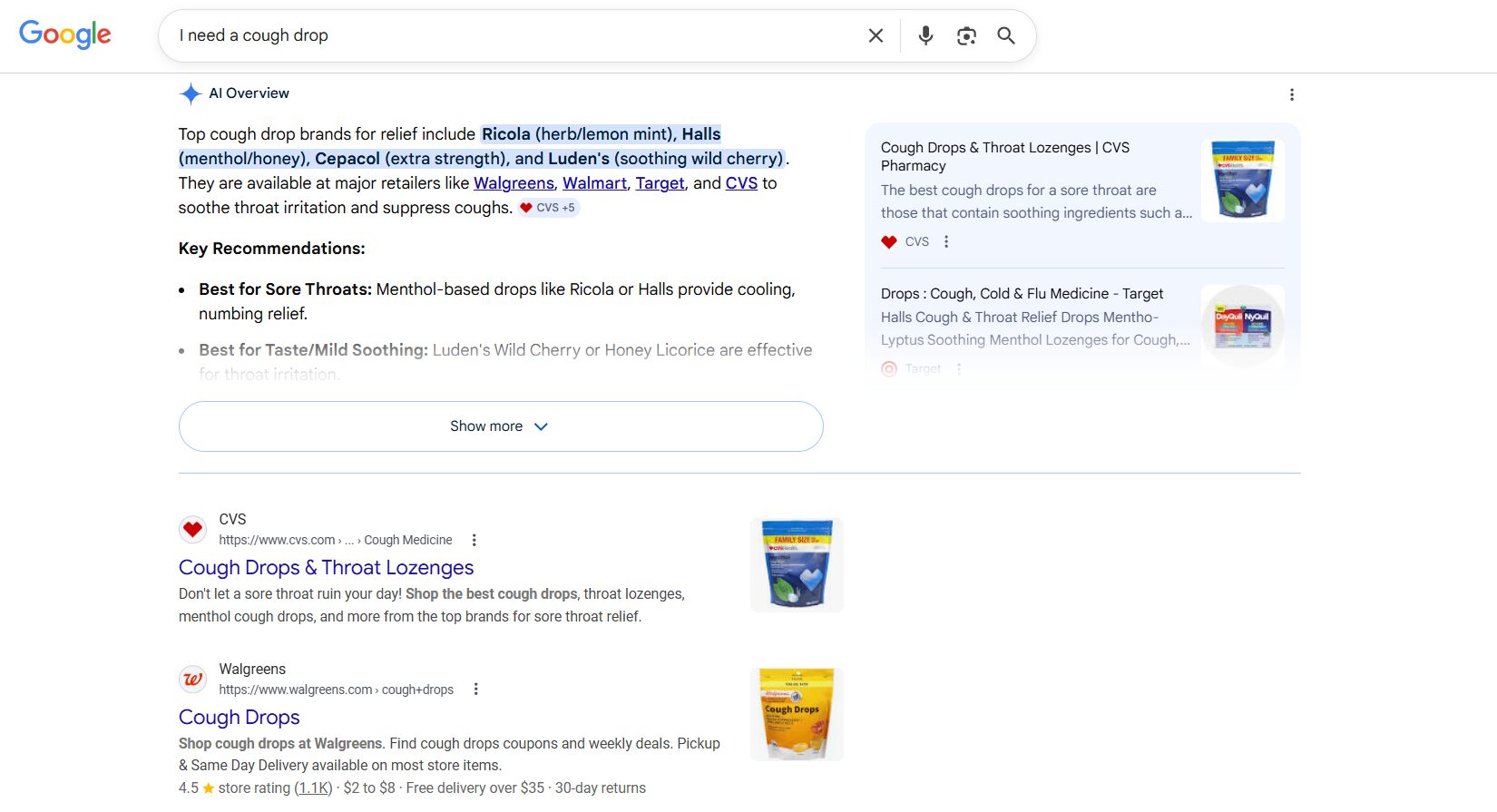
If you write “I need a cough drop” in ChatGPT, it provides a list of cough drops, with information on what symptoms each helps with. Essentially, AI isn’t just matching keywords; it’s trying to understand the meaning behind the search itself.

So for businesses looking to gain visibility within this new way of searching, here are a few key things to know about AI search:
- Semantic understanding: AI connects concepts, synonyms, and context. For example, “sore throat remedies” and “how to soothe a scratchy throat” are treated as similar.
- Natural language processing (NLP): AI breaks down sentences to extract meaning, entities, and sentiment. In terms of content, this means that AI isn’t just matching the nitty gritty, but actively judging the likelihood that your content actually answers a user’s questions.
- Summarization ability: Generative AI creates summaries and answers using content it finds—so clarity and structure are critical.
- No click required: Some AI platforms serve your content without a user clicking through, so you need to deliver value quickly and clearly.
How Can You Make Content More AI-Friendly?
So the good news is, it only takes a few tweaks to your writing and editing process to help your content be more AI-friendly.
Just remember, helpful, human-first content will always be the priority—but these tips will help you gain visibility in both traditional and generative engines (talk about a win-win!).
Incorporate Structured Data
Including structured data that clarifies both the structure and meaning of your content is crucial for both SEO and AI search.
This is typically done in two ways: through semantic tags (sometimes referred to as semantic HTML tags) and schema markup. While both serve the purpose of helping machines interpret web content, they do work differently:
Semantic tags are built into a website’s HTML, such as <article>, <header>, etc., to define the structure and purpose of content on a web page. These tags help browsers, search engines, and assistive technologies understand the hierarchy and meaning of content, improving accessibility, SEO, and maintainability of the codebase.
Schema markup is a standardized type of structured data added to your website’s code to explicitly define the meaning of your content and help machines understand what that content represents.
There are multiple types of schema that can be implemented on a page, allowing you to label everything from products and events to recipes and business locations. This added context can improve categorization and page indexing, and enhance visibility through rich snippets or AI-generated summaries.
Utilize Informative, Properly-Formatted Headings
Headings are what guides users, search engines, and AI to the answers they’re looking for on a page, so it’s essential that your headings are informative and accurately connect to the content that follows.
There should be a clear heading hierarchy with every page having only one H1, followed by H2s and H3s accordingly.
Now, because AI uses semantic understanding and recognizes natural language patterns, it’s more likely to cite content that mirrors how people phrase their searches. So, headings structured around the way users actually ask questions can help improve your chances of being featured in AI-generated answers.
For example, a heading like “How does schema markup help SEO?” directly reflects a common search phrase, helping to identify your content as highly relevant.
Now having clear structure within a page isn’t a new concept—it’s a key part of SEO, helpful content, and general web accessibility. But now it plays a direct role in how content is interpreted, displayed, and prioritized within AI search.
Leverage Long-Tail Keywords
Long-tail keywords reflect how people actually speak and ask questions, making them immensely useful for AI-driven search results. Using long-tail keywords naturally in content and strategically in headings can help boost recognition and relevance.
For long-tail keyword research, you can turn to:
- Google Analytics and Search Console
- Google Autocomplete
- AnswerThePublic
- Keyword Tools
- Online Forums (such as Reddit)
- Related Searches
Create Conversational, Purpose-Driven Content
Just like humans, AI also favors conversational, natural content.
This is due in part to the nature of how AI search works. Since AI leverages semantic understanding (connecting concepts, synonyms, and context) to deliver answers, its results tend to have a more conversational tone.
Plus a lot of AI search is happening directly with chatbots or chatbot-style search, which naturally makes the search experience more of a conversation rather than sifting through a list of traditional search results.
So, content that has a natural flow to it and important context clues aligns with both how people search and how AI delivers responses, making it easier for AI systems to feature your content in their results.
Some quick tips for writing natural, reader-friendly content:
- Stay professional: Aim for a tone that feels approachable without sacrificing clarity or credibility.
- Consider the user’s intent: Ask yourself: is the user trying to solve a problem? Compare options? Learn something new? Let that guide your approach.
- Avoid jargon: Use plain language whenever possible. If industry terms are necessary, explain them clearly. Your audience doesn’t want to hear jargon from you, why would they want it from AI?
- Answer questions naturally: Incorporate common questions and structure your content to respond in a clear, accessible way—this could include using question-based headings or asking questions directly in the copy.
With all this talk of writing, there is one important thing to keep in mind here: stay true to yourself. Everyone has a writing style; it’s just about tailoring it here and there to make the point you’re trying to make all the more effective.
Making your content easier for AI to understand should never come at the cost of its quality or authenticity. Now more than ever, having a unique voice is crucial, and it’s important not to lose sight of that in the effort of making content that is cited by AI.
Tip: Having comprehensive buyer personas can open the door for more effective, impactful copy. To learn more about buyer personas, you can check out my blog, Creating Buyer Personas for Better Marketing.
Keep Content Digestible
73% of people admit to simply skimming blog posts.

Humans naturally scan for key points when deciding to read or click away from a piece of content. So, it makes sense that AI models are designed to parse, scan, and summarize information efficiently.
Making your content digestible not only helps readers grasp your message, it also gives AI a clearer understanding of what points you’re making and the overall context of the content.
This can help you gain visibility in traditional search, boost your appearance in AI summaries, and increase citations in AI-given answers. And with nearly 60% of searches ending with no clicks, getting your content surfaced in featured snippets, AI Overviews, and directly within AI conversations has never been more important.
Some ways you can make your content more digestible include:
- Ensure that each section within your content focuses on the specific point you’re trying to make
- Avoid run-on sentences
- Utilize smaller paragraphs to avoid walls of text
- Use bullet points, numbered lists, and bolded phrases to help emphasize important content (AI loves lists!)
- Add a summary box or TL;DR with key information for long or dense sections
Does Word Count Impact Visibility in AI Search?
Now, with all this talk of digestible content, you might be wondering: “What about word count?”
It’s a fair question, and content length has always been a hot topic. I mean, there’s the famous Shakespeare quote, “Brevity is the soul of wit.”
Or, for fans of The Office, “Why waste time say lot word when few word do trick?”

Here’s my answer: Keeping content digestible doesn’t necessarily mean keeping it short. It means being purposeful.
In the words of my manager, things should be as long as they need to be. And remember, you can always break a larger topic up into a content pillar!
So, instead of focusing on word count, consider the following when writing and editing your content:
- Am I avoiding unnecessary jargon, fluff, or filler?
- Is each section leading to the main point I want to make?
- Is there an easy-to-follow structure to the content?
- Will my readers get the answers and information they’re looking for?
Whether it’s 300 words or 3,000 words, each part should serve a purpose—for education, context, or even an eye roll at a lame pun. If you’re doing that, you’re on the right track.
Incorporate FAQs
Including FAQ sections within your content can help AI retrieve information even more efficiently, since the format reduces filler, and FAQS often mirror how users naturally speak and search.
When it comes to creating your FAQ section(s), there are a few ways you could get started:
- Experience: Think of any common or repeated questions you get, and start with those! Typically, these will revolve around areas such as pricing, service areas, and service inclusions.
- Research: Check out your competitor’s FAQ pages, or leverage forum sites like Reddit to see what questions users are posting in relevant communities.
- AI: Prompt your preferred AI tool to provide a list of FAQs for your business/industry.
- User Queries: Use real user queries from tools like Google Search Console, Google’s “People Also Ask” boxes, or sites like Answer the Public.
- FAQ Services: A marketing agency can definitely help research and develop strong FAQs for your site.
When writing your FAQs, keep the formatting simple—one question, one straightforward answer. This way, everyone involved (AI, users, and traditional engines) can easily identify what they’re looking for.
Generative Engine Optimization (GEO)
Talking about AI-friendly content wouldn’t be complete without mentioning GEO.
GEO, or Generative Engine Optimization, is essentially SEO for AI search. GEO works hand-in-hand with SEO and focuses on optimizing areas that AI prioritizes, such as structured data, long-tail keywords, clear content… Basically, everything I mentioned above.
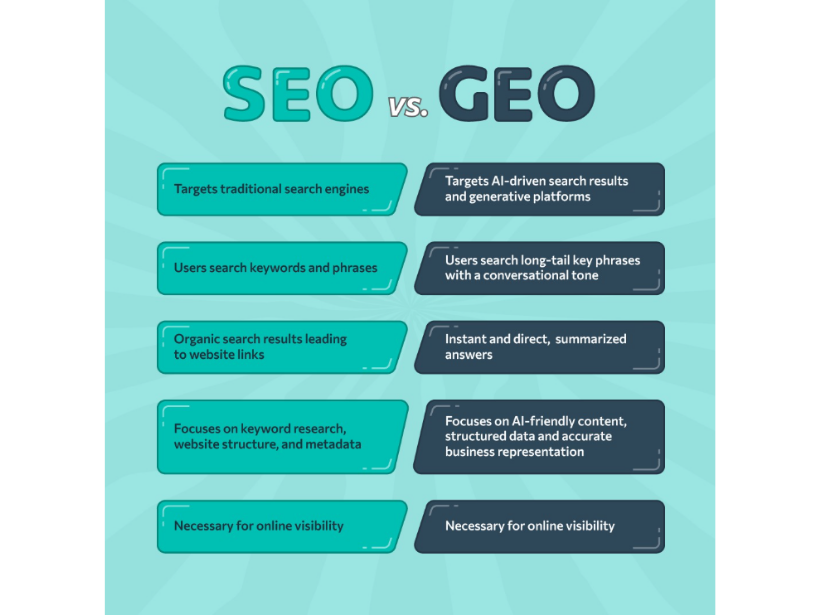
As AI becomes more integrated into how users find and interact with content, optimizing for AI search alongside your traditional SEO efforts ensures your brand stays relevant, discoverable, and trustworthy.
How to Check if Your Content is Showing Up in AI Search Results
While every piece of content won’t automatically surface in AI results, there are a few ways you can follow up on your efforts.
- Ask AI: Ask AI tools like ChatGPT or Claude to summarize or answer questions related to your topic or targeted keywords, and check if they reference or reflect your content.
- Google Search: Search for your target queries in Google and note whether your content appears in AI-generated summaries or is cited within them.
- Analytics: Tracking data from Google’s AI mode is now available within Search Console Reporting, making it simple to identify your AI traffic. Additionally, you can add custom filters to identify specific AI sources like ChatGPT.
There are also specific AI visibility tools—this article by Search Engine Land breaks down some of the top contenders.
Keep in mind that AI search is always evolving—systems are learning, improving, and updating responses over time. Because of this, changes in visibility or results may not happen right away, but consistent effort helps set you up for long-term success.
Key Takeaways
With all my talk of structure and clarity, I’d be remiss not to include a helpful list of some key takeaways:
- AI evaluates your content. Use optimized headings and clear hierarchy to help AI, search engines, and assistive devices understand your page.
- Semantic structure gives meaning. Use semantic tags for structure and schema markup for context so AI can better interpret your content.
- AI prioritizes intent-driven, natural language. Create FAQ sections, mirror audience language, and use long-tail keywords to help visibility.
- Proper formatting boosts readability and AI extraction. Use heading hierarchy and organize your page clearly so it’s easier for AI tools to pull relevant information for their summaries and snippets.
- Purpose improves performance. Keep content clear, aligned with user intent, and true to your unique voice.
- Measure and adapt for better visibility. Track AI interaction, citations, and performance using tools like ChatGPT, Google Search, and analytics platforms.
Moving Forward
As search continues to evolve, the best approach is to continue to create content that meets real needs, answers real questions, and adapts as search behaviors change.
By focusing on best practices like the ones in this blog, you can ensure your content is readable, valuable, and visible in traditional search and AI search alike.